Common Calorie Calculator Mistakes That Sabotage Your Progress
You’ve got your TDEE number, set your deficit or surplus, and you’re tracking diligently… but the scale isn’t moving, or worse, it’s going the wrong way. Sound familiar?
The issue usually isn’t your willpower or “broken metabolism”—it’s one (or more) of the sneaky mistakes people make when using calorie calculators. Research and real-world data show that over 30% of users see errors of 250–500 calories per day from standard TDEE tools, often due to avoidable pitfalls. These errors compound: 300 extra calories daily = ~30 lbs of potential fat gain (or stalled loss) over a year.
In this unique, no-fluff guide, we’ll cover the top 10 most common calorie calculator mistakes (drawn from user patterns, studies, and expert breakdowns), why they sabotage you, and exactly how to fix them using the James Smith Calculator for accurate, sustainable results. Let’s stop the sabotage and get your progress back on track.
1. Overestimating Your Activity Level (The #1 Killer)
Why it happens: 80%+ of people pick “Moderately Active” or “Very Active” because they train 3–5 days a week. But calculators multiply your entire day’s burn based on that category.
Sabotage level: Adds 300–700 fake calories to your TDEE → you eat at “maintenance” but gain fat slowly.
Reality check:
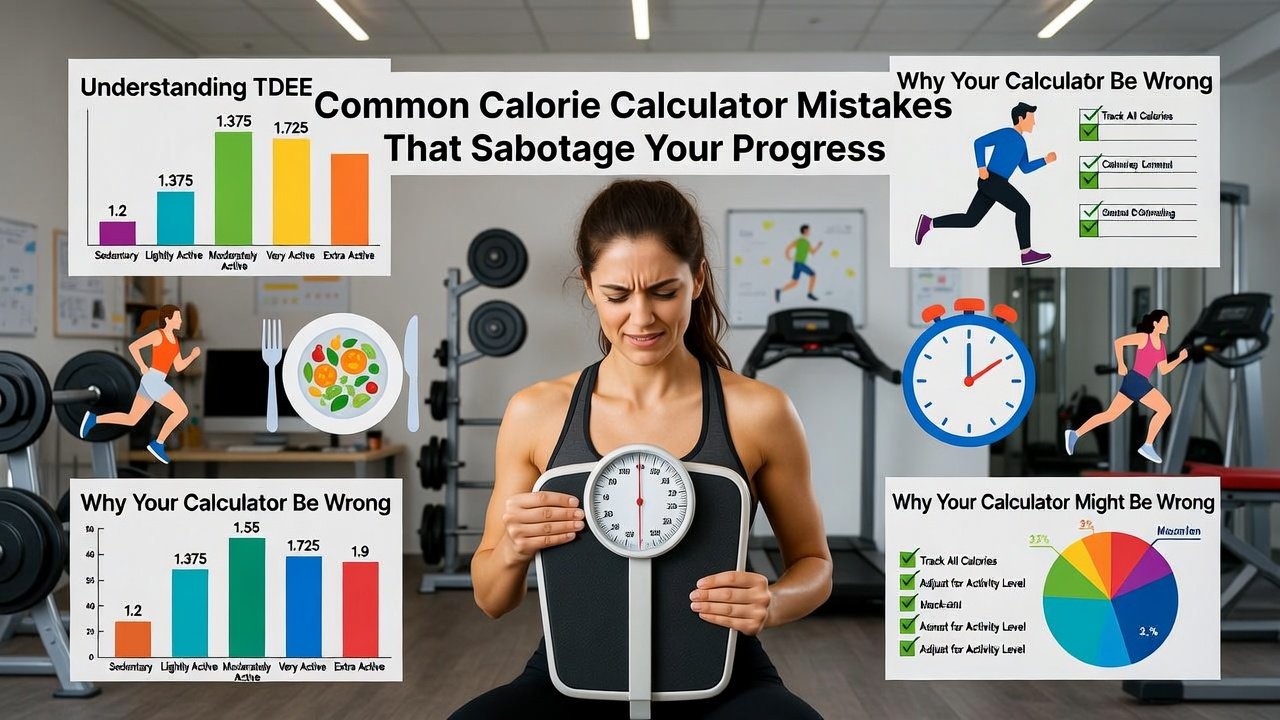
- Sedentary (desk job + workouts 3×/week, <5–6k steps): ×1.2
- Lightly Active (consistent light movement, 6–9k steps): ×1.375
- Only “Very Active” if hard training 6–7 days + physically demanding job.
Fix: Track steps for a week. If under 8,000 average (excluding workouts), drop to Sedentary or Light. Recalculate TDEE lower—many see 400+ kcal drop and finally start losing.
2. Not Adjusting for Body Composition (Muscle vs. Fat)
Why it happens: Standard formulas (Mifflin-St Jeor, Harris-Benedict) use averages and don’t factor lean mass directly.
Sabotage: Very muscular people underestimate TDEE; higher body-fat folks overestimate it slightly.
Fix: Use the James Smith Calculator (it handles realistic estimates well). For precision, track actual progress: Eat at calculated maintenance 2 weeks. Stable weight = accurate. Adjust ±100–200 kcal based on outcome.
3. Ignoring NEAT Drop During Dieting
Why it happens: When in a deficit, subconscious NEAT (fidgeting, pacing, standing) drops by 200–500 kcal/day without you noticing.
Sabotage: Your real TDEE falls → deficit shrinks → plateau.
Fix: Boost NEAT deliberately (stairs, walking calls, standing desk). Recalculate TDEE every 4–6 weeks as weight changes and adaptation kicks in.
4. Using the Calculator Once and Never Recalculating
Why it happens: Weight loss lowers BMR/TDEE (less mass to maintain + adaptation).
Sabotage: You keep the same intake → deficit vanishes → stall after 10–20 lbs lost.
Fix: Re-run the James Smith Calculator every time you lose/gain 5–10 lbs or change activity. Small weekly tweaks beat big overhauls.
5. Relying on Fitness Tracker “Calories Burned” Add-Ons
Why it happens: Watches overestimate exercise burn by 20–90% (Stanford studies confirm).
Sabotage: You “earn” extra food → erase your deficit.
Fix: Use calculator TDEE as baseline. Add exercise calories only if very precise (e.g., lab-tested). Better: Treat workouts as part of activity level, not extras.
6. Inaccurate Food Tracking (The Silent Saboteur)
Why it happens: Eyeballing portions, forgetting oils/condiments, underestimating restaurant food.
Sabotage: Actual intake 200–500 kcal higher than logged.
Fix: Weigh everything for 1–2 weeks to calibrate eye. Use food scale + app. Account for cooking oils (1 tbsp = 120 kcal). Track beverages/snacks religiously.
7. Choosing Too Aggressive a Deficit/Surplus from Day 1
Why it happens: Calculator says TDEE 2,500 → people jump to 1,500 for “fast results.”
Sabotage: Hunger, fatigue, muscle loss, metabolic slowdown → unsustainable, rebound gain.
Fix: Moderate: -300–500 kcal for fat loss, +200–400 for muscle. Sustainable beats speedy.
8. Ignoring Biofeedback and Scale Fluctuations
Why it happens: Relying only on calculator number, ignoring energy, sleep, hunger, strength.
Sabotage: Numbers say deficit but you’re exhausted → overtraining or under-recovery.
Fix: Use calculator as starting point. Monitor weekly average weight + measurements + how you feel. Adjust up if drained, down if no progress.
9. Falling for “One-Size-Fits-All” Myths
Myths debunked:
- “Women need way fewer calories” → true on average, but use female setting.
- “Eating late slows metabolism” → timing minor vs. total calories.
- “Certain foods boost metabolism hugely” → negligible effect.
Fix: Stick to evidence: Calories in vs. out rules, but quality affects adherence.
10. Not Factoring in Life Changes or Cycle Variations
Why it happens: New job, illness, menstrual cycle (women: +100–300 kcal luteal phase).
Sabotage: Temporary stalls blamed on “metabolism broke.”
Fix: Adjust flexibly. Women: track cycle effects. Life stress? Lower activity multiplier temporarily.
How to Bulletproof Your Approach with the James Smith Calculator
- Input honest stats (sex, age, height, weight).
- Select conservative activity level (drop one if unsure).
- Get TDEE → set moderate goal calories.
- Track intake/weigh food 100% for 2 weeks.
- Monitor weekly average scale + biofeedback.
- Recalculate every 4–6 weeks or big changes.
- Prioritize protein (1.6–2.2g/kg), sleep, strength training.
These tweaks turn calculator guesswork into data-driven progress.