Women’s Calorie Calculator Guide: Why You Might Need Fewer Calories Than You Think
If you’re a woman trying to lose fat, build muscle, or just maintain your weight, you’ve likely punched your stats into a TDEE calculator and thought, “That seems low—shouldn’t I be eating more?” You’re not alone. Many women overestimate their calorie needs, leading to stalled progress, constant hunger, or unexpected plateaus.
The truth is: women generally require fewer calories than men—even at similar heights, weights, and activity levels—due to differences in body composition, hormones, and metabolism. In this detailed guide, we’ll explain exactly why that happens, how to accurately calculate your real needs using the James Smith Calculator, common mistakes women make, and practical tips to set up sustainable calorie targets. Let’s get your numbers right so progress feels effortless (or at least consistent!).
Why Women Often Need Fewer Calories: The Science Breakdown
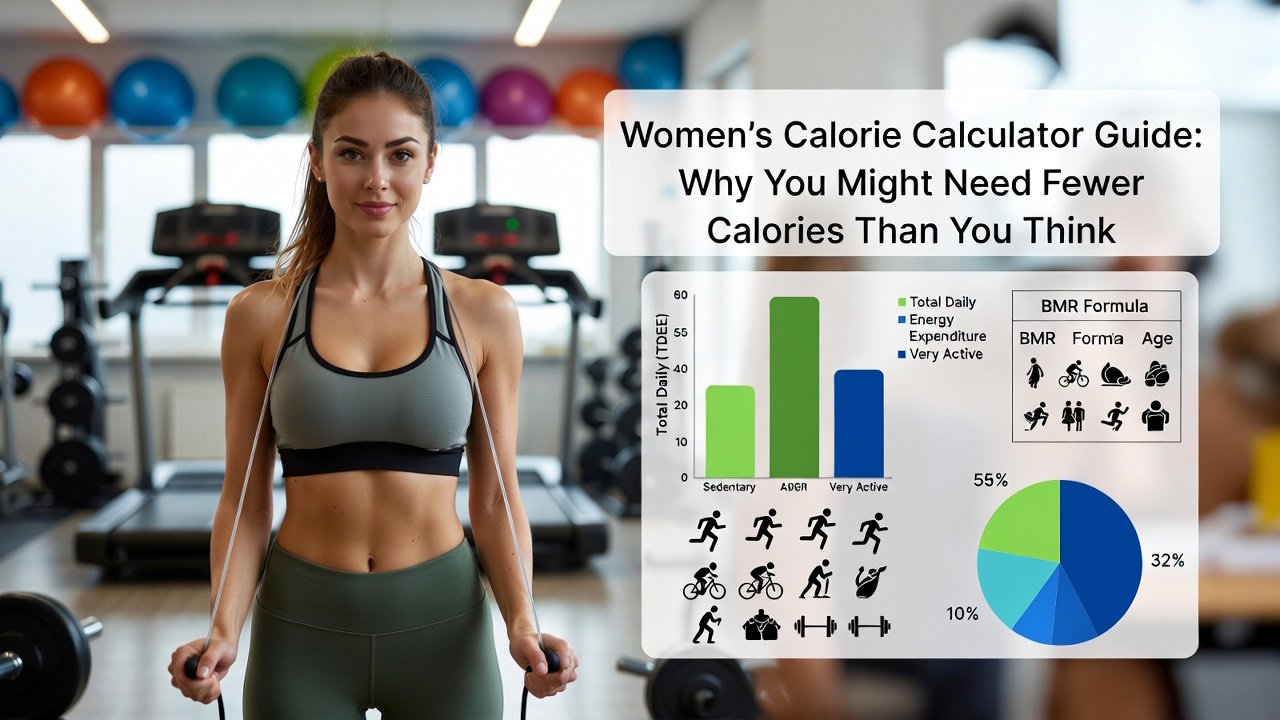
Calorie needs boil down to TDEE (Total Daily Energy Expenditure) = BMR (Basal Metabolic Rate) × Activity Multiplier.
The biggest gender difference shows up in BMR—the calories your body burns at complete rest for basic functions like breathing, circulation, and cell repair.
Key reasons women typically have a lower BMR (and thus lower TDEE):
- Lower Muscle Mass on Average Muscle is metabolically active tissue—it burns calories even at rest. Men naturally have more lean muscle mass (thanks to higher testosterone), while women tend to have a higher percentage of body fat (essential for reproductive health). Result: For the same body weight, men burn 5–10% more calories at rest. Studies show men’s BMR is often 200–300+ kcal higher than women’s of similar size.
- Smaller Average Body Size Women are, on average, shorter and lighter than men (e.g., average woman ~5’4″ / 170 lbs vs. man ~5’9″ / 200 lbs). Smaller bodies require less energy to maintain. Even height-adjusted, the muscle difference persists.
- Hormonal Influences Estrogen promotes fat storage (especially in hips/thighs for childbearing), while testosterone boosts muscle and metabolism. Women’s bodies are also more efficient at conserving energy during calorie deficits—a survival adaptation.
- Real-World Numbers
- Average adult woman BMR: ~1,400–1,500 kcal/day
- Average adult man BMR: ~1,600–1,800 kcal/day
- Maintenance TDEE for moderately active woman: often 1,800–2,400 kcal
- For men: 2,200–3,000+ kcal
Common Mistakes Women Make with Calorie Calculators
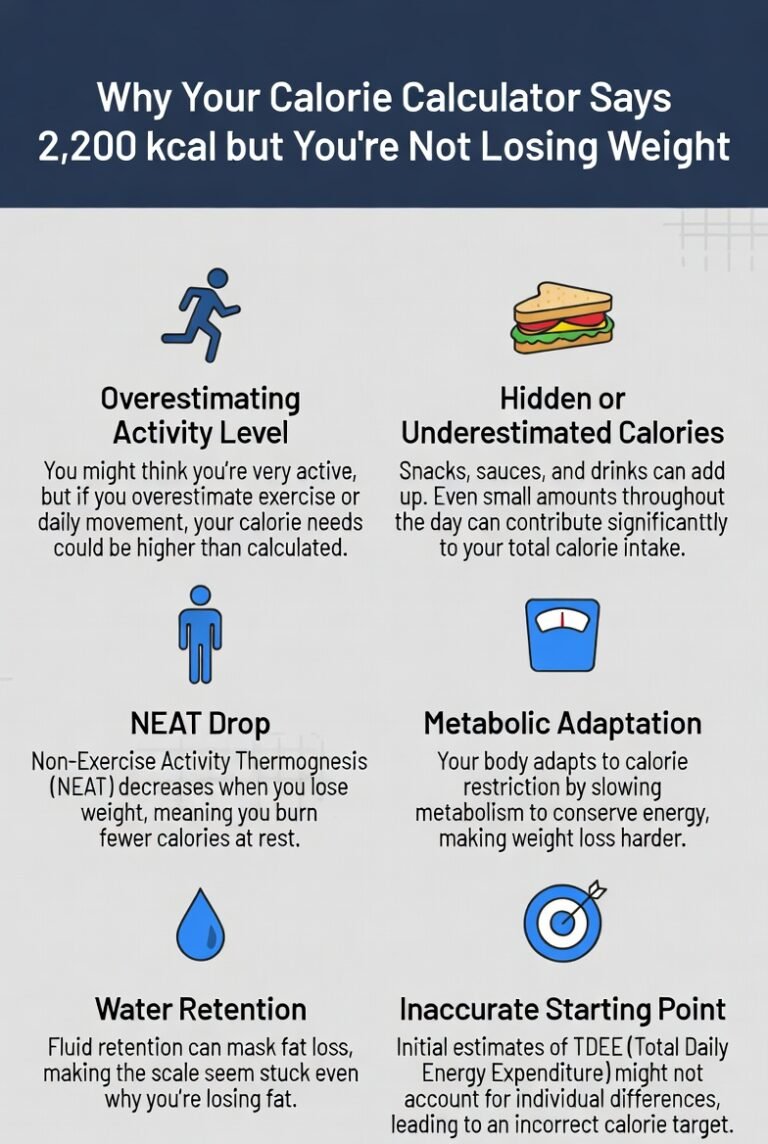
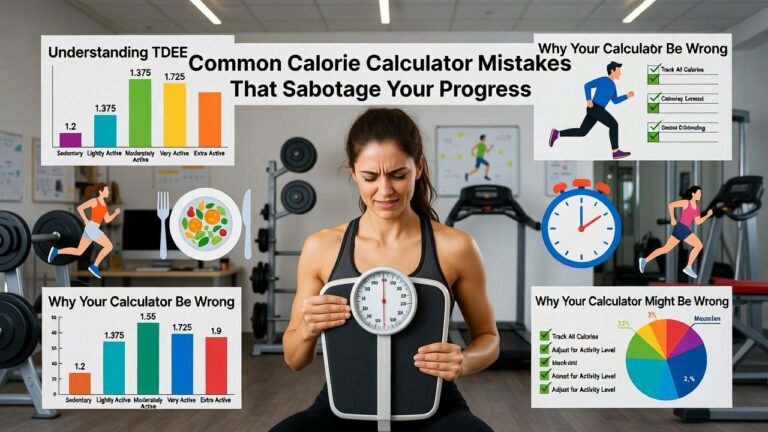
- Overestimating Activity Level “I workout 4–5 days a week” → many select “Moderately Active” or “Very Active,” adding hundreds of extra calories. But if the rest of your day is desk-based with <8,000 steps, you’re likely closer to Sedentary or Lightly Active.
- Ignoring Body Composition Calculators use averages. A very lean, muscular woman might need slightly more; someone with higher body fat might need less than predicted.
- Using Male-Focused Benchmarks Seeing “eat 2,500 kcal to maintain” everywhere and thinking it’s universal—it’s often based on male data.
- Not Accounting for Age or Menstrual Cycle BMR drops ~1–2% per decade after 20. Hormonal fluctuations (e.g., higher needs in luteal phase) can add/subtract 100–200 kcal temporarily.
- Underestimating Adaptive Thermogenesis Prolonged deficits lower metabolism more in women, so aggressive cuts backfire faster.
How to Use the James Smith Calculator Correctly as a Woman
- Input Accurate Stats
- Height, current weight, age
- Select Female (this adjusts the BMR formula—Mifflin-St Jeor or similar accounts for sex differences)
- Choose Realistic Activity Level
- Sedentary (desk job, <5k steps): ×1.2
- Lightly Active (light exercise 1–3×/week, 5–8k steps): ×1.375
- Moderately Active (consistent training 3–5×/week, 8–10k+ steps): ×1.55
- Very Active (intense daily training + active job, 12k+ steps): ×1.725 Tip: When in doubt, go one level lower. It’s easier to increase calories if you’re losing too fast.
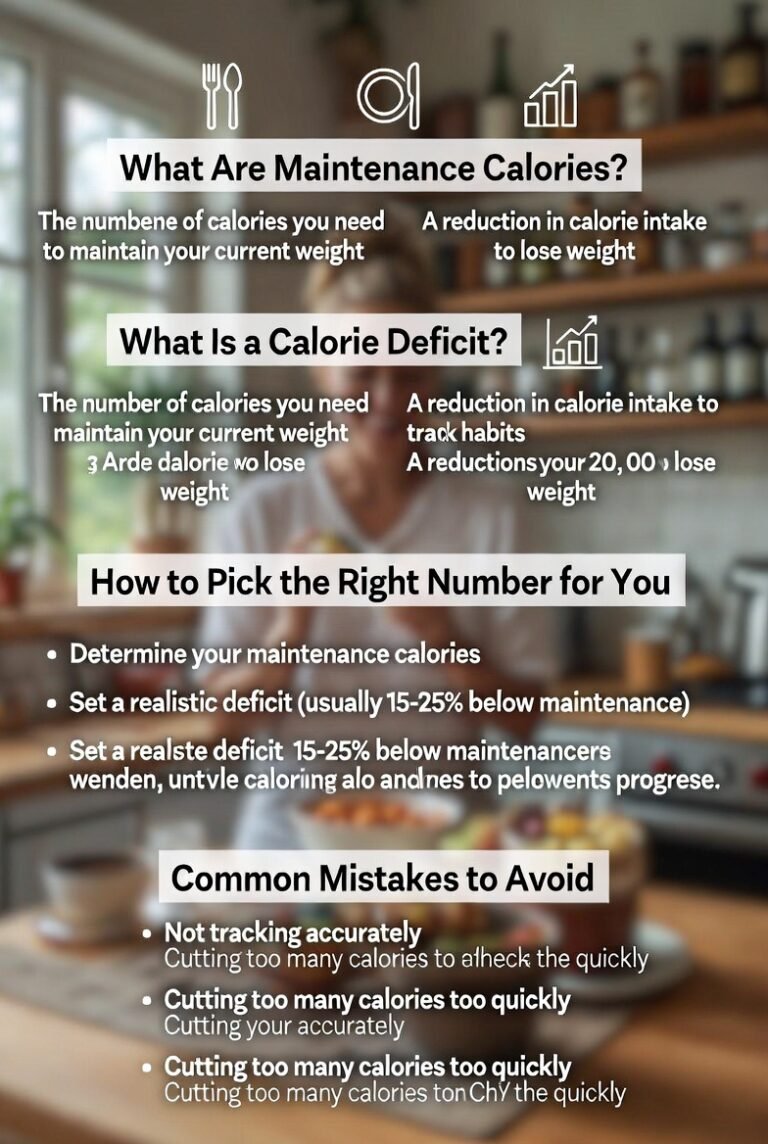
- Get Your TDEE This is your estimated maintenance calories. Track intake at this level for 1–2 weeks (accurately—use a food scale).
- Weight stable → spot on
- Gaining → overestimated activity or intake
- Losing → underestimated (rare)
- Set Goals
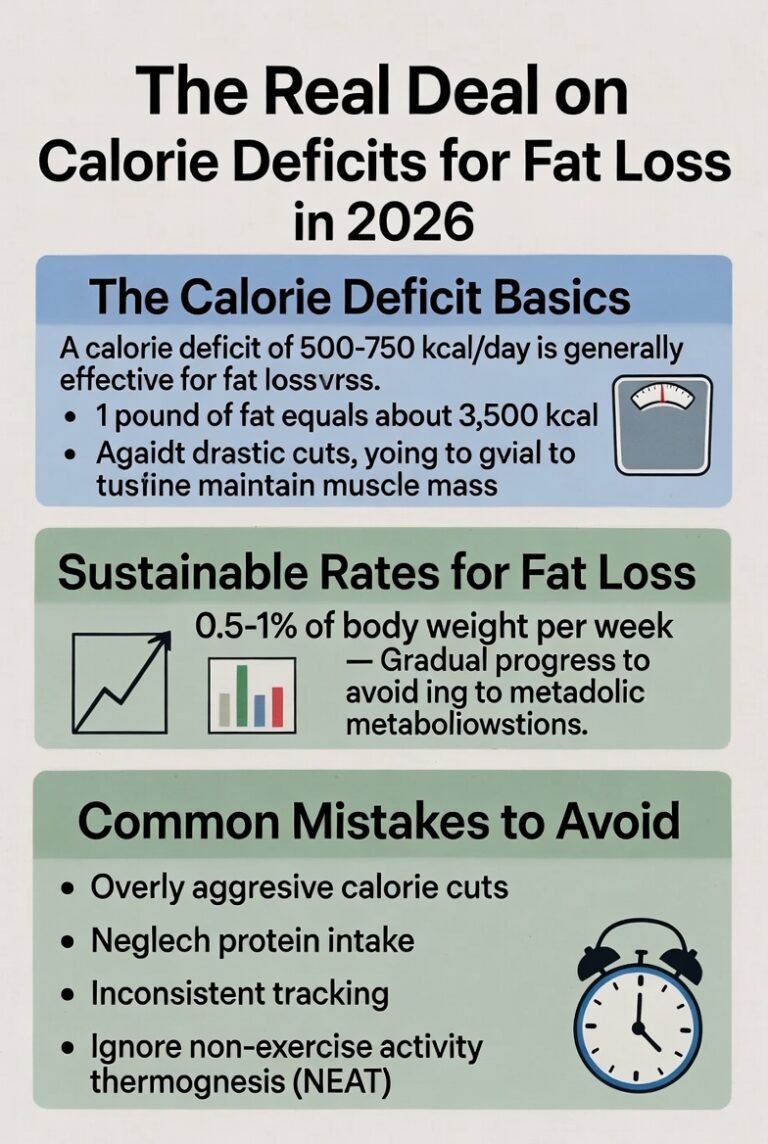
- Fat loss: -300–500 kcal deficit (0.5–1 lb/week)
- Maintenance: Eat at TDEE
- Muscle building: +200–400 kcal surplus (small for lean gains) Never drop below ~1,200–1,400 kcal long-term to avoid nutrient shortfalls and metabolic slowdown.
- Reassess Regularly Every 4–6 weeks or after 5–10 lbs change. Weight loss lowers TDEE, so recalculate.
Example Scenarios for Women
- 30-year-old, 5’5″, 150 lbs, office job + gym 3×/week → Likely Lightly Active → TDEE ~1,900–2,100 kcal Fat loss target: 1,500–1,800 kcal
- 35-year-old, 5’7″, 170 lbs, moderately active (walks a lot + trains 4–5×) → Moderately Active → TDEE ~2,200–2,400 kcal Maintenance or slow recomp: around 2,200 kcal
- Very lean athlete, 5’4″, 130 lbs, training 6×/week intensely → Very Active → TDEE ~2,300+ kcal (higher due to muscle)
Practical Tips to Make It Sustainable
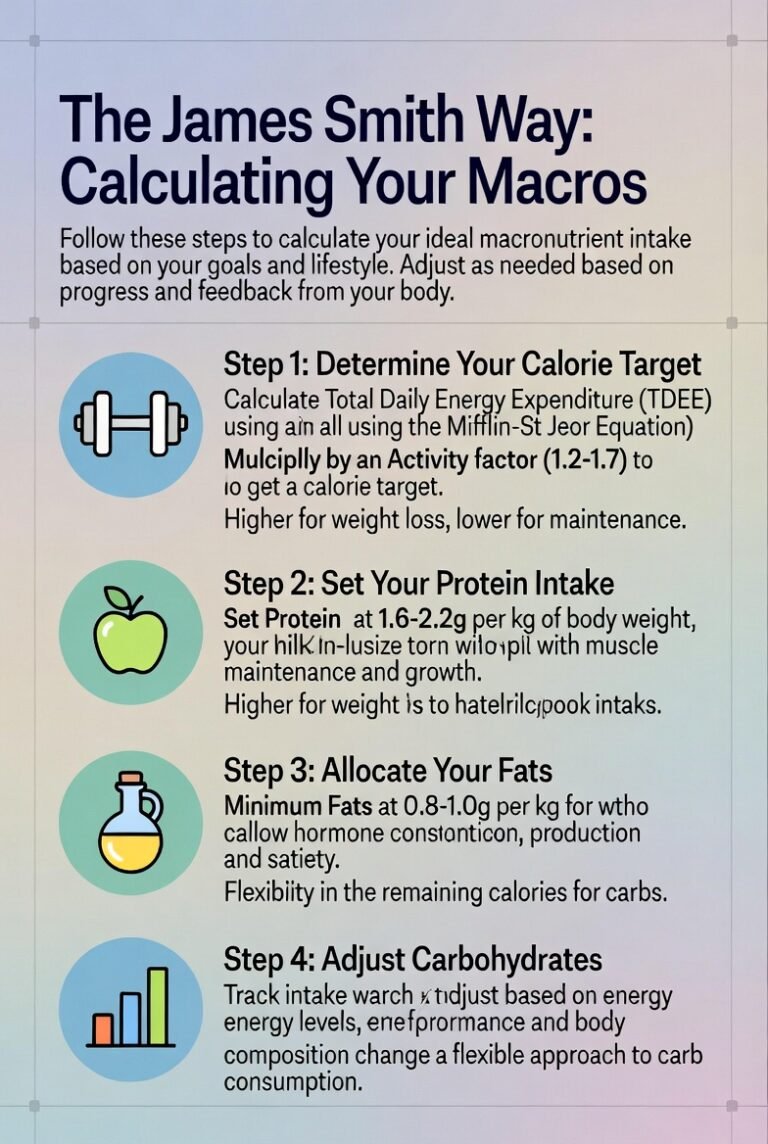
- Prioritize Protein: 1.6–2.2 g/kg bodyweight—keeps you full and preserves muscle (women benefit extra here during deficits).
- Track NEAT: Steps, standing, fidgeting—these add up more than you think.
- Cycle Calories if Needed: Higher on training days, lower on rest (helps with hormones).
- Listen to Biofeedback: Fatigue, stalled progress, irregular cycles → increase calories.
- Focus on Nutrient Density: Hit veggies, fiber, healthy fats—more satiety on fewer calories.
Wrapping It Up: Embrace Your Unique Numbers
Women don’t “need fewer calories” because we’re weaker or less deserving—we need them because our bodies are built differently, and that’s okay. Stop comparing to men or generic advice. Use the James Smith Calculator with honest inputs, female sex selected, and realistic activity—and watch how much easier consistency becomes.
Your metabolism isn’t broken; it just has different math. Plug in your stats today, set a smart target, and fuel your body properly. Progress will follow.