How Accurate Is the Mifflin-St Jeor Formula? (And Why We Use It)
You plug your stats into a calorie calculator and get a TDEE of 2,500 kcal. But is that number gospel? The heart of every good calculator (including ours) is the Mifflin-St Jeor formula for BMR — the calories burned at complete rest. People obsess over “Is it accurate?” The short answer: It’s the best general tool we have in 2026, predicting within ~10% of measured values for most people. But it’s not perfect — no formula is.
This post breaks down the real accuracy of Mifflin-St Jeor based on recent studies (2024–2026), why it beats older ones like Harris-Benedict, its limitations, and why we still use it for real-world fat loss/muscle gain. Spoiler: The formula gets you close; tracking your actual progress gets you exact.
What Mifflin-St Jeor Actually Calculates (And How)
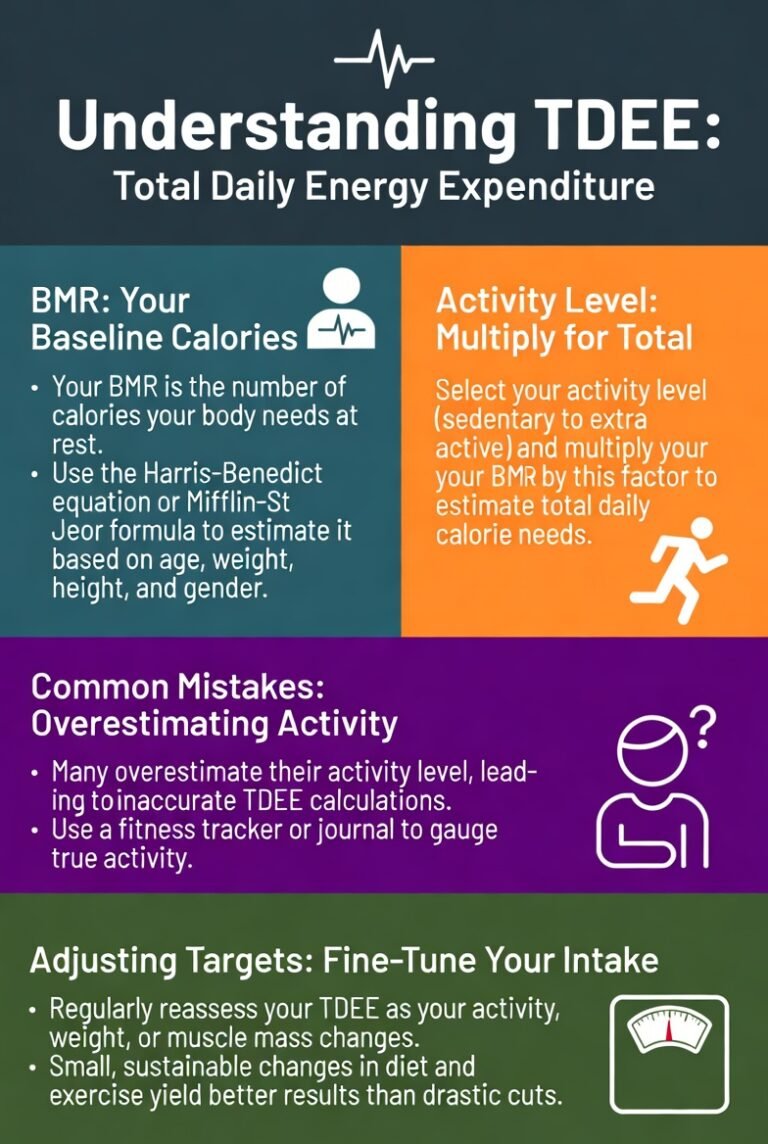
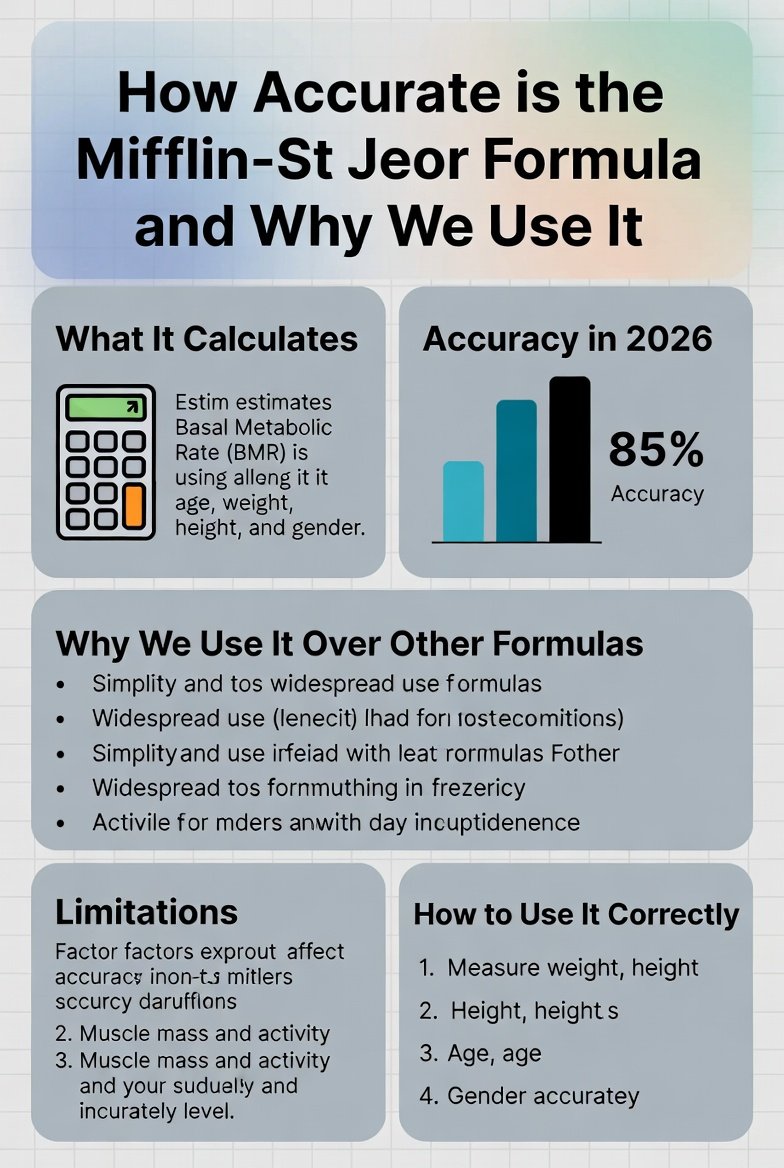
Mifflin-St Jeor (1990) estimates Resting Metabolic Rate (RMR) or Basal Metabolic Rate (BMR) — basically the same thing for practical purposes.
Formulas:
- Men: BMR = 10 × weight (kg) + 6.25 × height (cm) − 5 × age + 5
- Women: BMR = 10 × weight (kg) + 6.25 × height (cm) − 5 × age − 161
Multiply by activity factor for TDEE. Simple inputs (age, sex, height, weight) — no need for body-fat scans or labs.
How Accurate Is It in 2026? (The Evidence)
Recent studies (including 2025–2026 reviews on diverse groups like Emirati females, hospitalized patients, obese adults, athletes, and general populations) consistently rank Mifflin-St Jeor as:
- Most accurate general equation: Often predicts RMR within 10% of measured (indirect calorimetry) for 55–73% of people — higher than Harris-Benedict (overestimates 5–15% in modern populations), WHO/FAO/UNU, or Owen in head-to-heads.
- Low bias: Mean differences typically -15 to +84 kcal/day (minimal over/underestimation) across BMI ranges; unbiased or slightly under in many groups.
- Better than Harris-Benedict: HB (1919/1984 revision) overestimates in non-obese/younger people and has wider errors; Mifflin uses more modern data (498 subjects, including obese).
- Top performer in meta-analyses: Systematic reviews (e.g., 2005 classic still cited, plus 2023–2026 updates) show it edges others for non-obese/obese adults; accuracy ~60–82% within ±10% in community-living people.
Examples from recent data:
- Emirati young females (2025–2026 study): Mifflin most accurate among 9 equations (~60% within target).
- Obese/severe obesity: Often least biased or most adequate (90–110% range); some studies show slight underestimation but better than HB overestimation.
- Athletes/masters: Mixed, but often close or best among weight/height/age equations.
- Hospitalized/critical care: Underestimates more (like all equations) due to inflammation/stress — but still usable baseline.
Error is usually ±100–200 kcal (5–10%) for individuals — good enough for starting points. Genetics, muscle mass, hormones, ethnicity add variance no formula catches perfectly.
Why We Use Mifflin-St Jeor (And Not Something Else)
- Best balance for general population: Large validation sample, modern (1990), includes obese/non-obese — fits most users of calorie calculators.
- Conservative estimates: Slight under-prediction in some groups prevents overeating in deficits (James Smith style: better to start low and add than overestimate and stall).
- Simple and accessible: No body-fat % required (unlike Katch-McArdle or Cunningham — more accurate if you have DEXA, but most don’t).
- Evidence-backed standard: Dietitians, apps, and guidelines (e.g., ADA-aligned) recommend it over HB for accuracy in 2026.
- Real-world wins: When paired with honest activity multipliers and 2-week tracking, it gets people losing 0.5–1% bodyweight/week reliably.
Alternatives like Oxford/Henry or new FFM-based may edge it in specific cases (e.g., high obesity or known lean mass), but for broad use without scans — Mifflin wins.
Limitations: Where It Falls Short
- Specific populations: Underestimates in hospitalized/inflamed (CRP high), severe obesity extremes, certain ethnicities (e.g., some Asian/Latin groups), or very muscular/athletes.
- Individual variation: ±10–15% due to genetics, thyroid, NEAT — always a starting estimate.
- Not for extremes: Crash diets, pregnancy, elderly hospitalized — indirect calorimetry or tailored equations better.
- Aging/weight change: Recalculate as you lose/gain — BMR drops ~20–25 kcal per kg lost.
How to Use It Right (The No-BS Way)
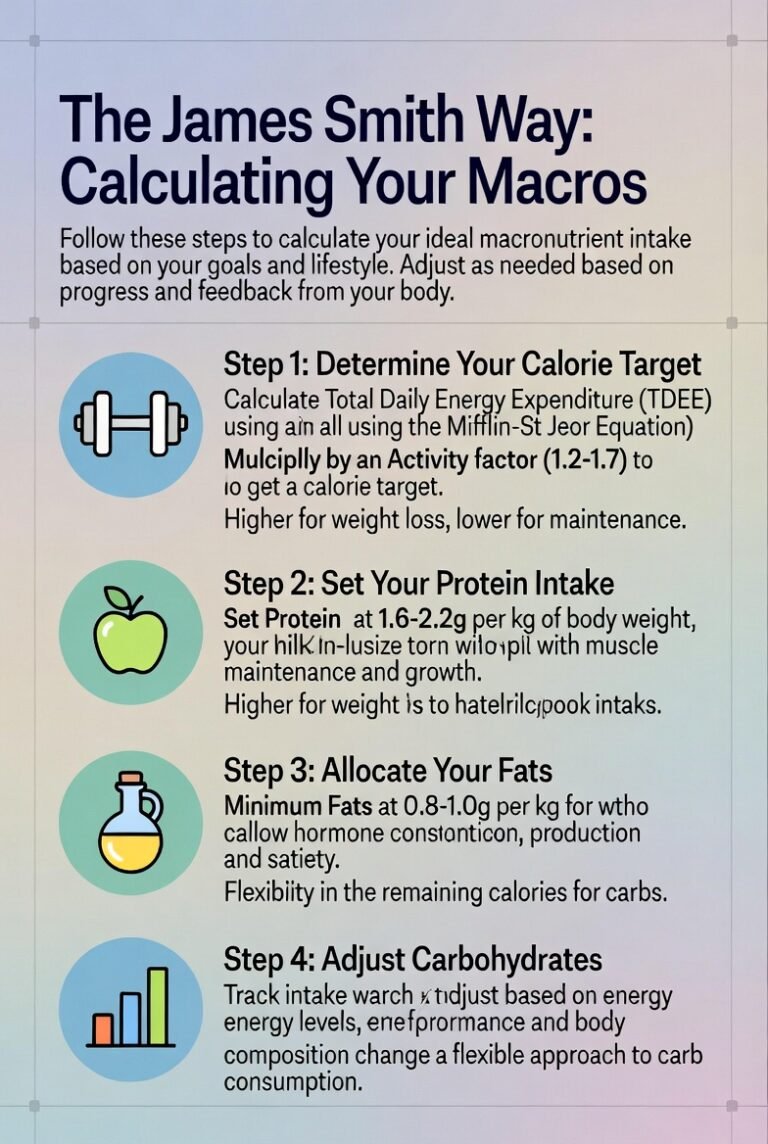
- Run it via our James Smith Calculator — conservative activity to avoid inflation.
- Track intake/weight 2 weeks accurately.
- No progress? Adjust down 100–200 kcal or up steps — formula was close, but reality rules.
- Re-run every 4–6 weeks or 5–10 kg change.
The Mifflin-St Jeor isn’t magic — it’s math that’s been battle-tested better than the rest. It gets you in the ballpark fast. Your scale, mirror, energy, and lifts tell the truth.
Plug your numbers in now — get your BMR/TDEE/macros. Track honestly for 14 days. Adjust based on results, not perfection.